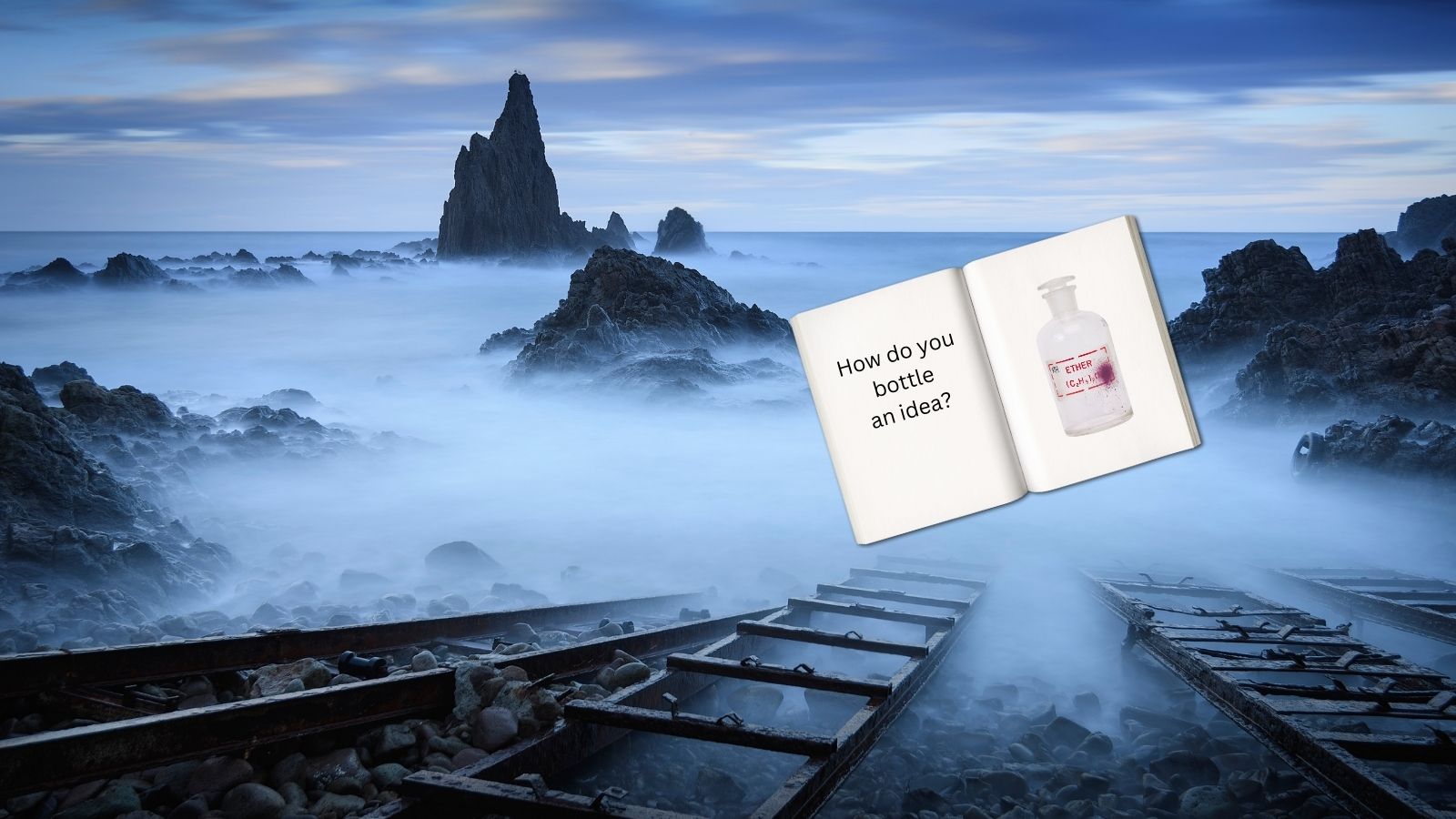
Let’s blether about the ether.
I’m not going to sugarcoat this. Writing can be hard.You’re taking little black marks and making an experience for someone you don’t know. You can’t really see it objectively for a long time. In fact you can’t see it, period, for most of its creation.
Knitters have wool, sculptors have clay or metal, carvers have wood, painters have canvas and paint.
Writers don’t have the material world. Our works in progress live in our brains, or in the ether (cloud), or in our computers, or (at their most tangible and probably their messiest) in a notebook or a pile of paper.
I used to swear by thinking of each book as a project that can be executed logically. Now, I’m not so sure. Any project requires a process for doing the actual work, and those processes are sometimes hard to arrive at.
In my 20s and 30s, I got up early, stayed up late, and wrote five bad novels that I never sent out to anyone because I knew they were bad. I didn’t know about editors. I didn’t even know much about revision. I thought it meant tweaking sentences, not doing the deep work a story often needs after its first draft.
Those manuscripts don’t exist anywhere now. I had a couple of them on a floppy disc. Ha ha! It disappeared some time in the 90s. Last August, I dropped the rest–a bunch of old hard copy manuscripts, some in multiple drafts–into the giant recycling bin at the zero waste facility.
I feel now that if I want to write about something, the idea will come to me fresh and I probably have better writing skills now than I did in my 30s. We hope! So I don’t really need to look through old stuff or try to salvage anything from my earlier work.
Now that the old stuff is gone, I’m getting obsessed with the process of bringing an idea from the ether to the page. I’ve done it every way I can think of:
- talked it into a voice memo recorder on my walks, then typed it all up and carved it into a book (that’s how I wrote most of Fiction Editing: A Writer’s Roadmap).
- kept a small notebook on my person and wrote ideas in it as they camedid chunks of writing on an app like 750words.com (that’s how I generated the first 2/3 of a draft of a historical novel)
- took a couple of weeks off work and went hard on the project, writing as much as possible and putting myself through hell (this is a lot more fun and pleasant if you are in a residency, like the fabulous Mineral School).
- got up at 5 am for months in a row, and wrote for 2 hours before work
- conceived and wrote a novella in a 72-hour period (that is the International 3-Day Novel contest)
Each of these processes has worked at one time or another. The 72-hour one works every year. But now I’m eyeing the other ones askance.
BECAUSE…I’m getting close to starting another novel. There’s that fizziness of a new idea coming toward me. Right now it’s a dot on the horizon, but if I can just stand still and let it come, it may turn into a massive steam train hurtling down the track. So the process is top of my mind.
To start with, I’m going to do everything in my power to get my mental and physical health to a place where I can jump on for the ride.This is because there’s almost nothing harder than writing a novel, in my experience. I’ve given birth twice, circumnavigated the globe three times, written nonfiction books, been broke, been lonely, bitten off more than I could chew, been married, gotten divorced, skated close to addiction, run two businesses, and still…the novel form is my Everest and my K2.
Cheers,
Pat
| I’m writing stuff (short pieces) about my 3-Day Novel contest experience with the idea that they might come in handy to help move some copies of the book, which is coming out this fall from Anvil Press. Sometimes I get in my own way with writing (yes!) so I’m taking a course on writing freelance articles from Amber Petty, who is one of the best teachers I’ve encountered in decades of learning how to write. Each week we are assigned a different type of article–last week it was a “listicle,” which I finally realized means ‘an article in the form of a list.’ (I have always thought listicles somehow related to popsicles.) Remember how much I love Betsy Lerner’s newsletter? Well I still love it, but I’m mad at her. She got obsessed with TikTok and stopped writing emails for weeks and weeks. She came back, yes…but the emails are sporadic. As a show of independence, I don’t open them for a few days. Sometimes I forget how childish I can be until something like this lays it bare. I’m about to start teaching next week and have the usual combination of joy and nerves. The course sold out fast! It’s my last time teaching Developmental Editing for Fiction live (on Zoom) with Editorial Arts Academy. The course started as a few notes on a flipchart back in 2019 and it has been very successful and a ton of fun to teach. Weird to feel the end of an experience, yet it’s the right thing to do. |
Fun Fact about Book Word Counts
Did you know you can find out the approximate word count of a book without having to count the words? This can come in handy if you’re putting together a book proposal or a list of comparative titles for a book you’re working on. Check it out at readinglength.com — search for any title. The Song of Solomon by Toni Morrison, for example, is about 88,000 words.