


Guess what the writer’s #1 roadblock is!
It isn’t lack of time. That might be on the list, but it’s not #1.
It ain’t lack of resources. Lots of people have written books despite lacking external resources.
It’s not lack of money. Money can buy you time, coaches, and feedback, but it can’t help you actually write the book.
It isn’t lack of motivation. If you want to write a book…if you’re halfway through a draft…if you talk about writing the book, or think about it, or wish it were easier, then you’re motivated.
So…what’s the problem?

The problem is……SELF-DOUBT!!!
There’s quite a few products out there to help with this. I sometimes listen to a hypnosis MP4 called “Be a Better Writer.” Spoiler: it advises writers to know their reader and write confidently. I’ve been finding it helpful, actually, to combat my own self-doubt.Then there’s Mason Currey, author of the Daily Rituals books and of Subtle Maneuvers, a newsletter that focuses on the writer’s self-doubt.
In fact, there’s an entire service industry of coaches to help writers with mindset and other things. Some are ‘life coaches’ who’ve niched. Others come from an editorial or publishing background. Some of the editorial types give feedback, provide accountability, and help build writing skills. There are good coaches and crap coaches, like in any other service industry.
But the roadblock is not self-doubt.
The self-doubt creates the roadblock, which is avoidance. You avoid the book you’re writing because maybe you don’t like being uncomfortable and incompetent. That’s the case for me.
Self-doubt and avoidance are insidious. They can have you reaching for the TV remote (or the phone, the book, the leftover Halloween candy) rather than facing the PROJECT, whatever it is.
This avoidance might look like time-consuming research into minor points, or ineffectually hovering over the project then getting right into tidying your desk. It might look like watching historical dramas to absorb the way characters dress and move. It could even look like throwing yourself into a smaller, easier writing project, helping out a needy relative, or planning a murder. All of these can seem a lot easier than writing a book, TRUST ME.
So what’s the cure?

Much like these rock-and-roll gentlemen pictured above (shortly after leaving the hair salon, I’m sure), the cure is ACCEPTANCE.Accept the self-doubt and write the thing anyway.
Action (writing) = Results (a book)
The self-doubt won’t go away, but as the pages pile up you’ll have evidence that doubt is not actually a roadblock…it’s just a feeling.
In fact, that feeling is probably a good sign. It means that the project matters to you, or that being a writer matters to you.
Practical Tools to combat avoidance
If you’re not up for self-hypnosis, a writing coach, or reading about other writers’ doubts, here’s a practical tool that can jump-start or re-start your writing project.
Design a few straitjacketish restrictions, then go for it (preferably shouting, “Balls to the wall!” like a character in a really enjoyable novel I’m editing).
A great restriction is limiting your writing time. Not setting a deadline, but assigning a specific block of time in which to get something down or die trying. “I have thirty-seven minutes to draft this scene.”
Or if you like deadlines but don’t observe self-imposed ones, consider bringing in someone you can’t disappoint. For example, swapping manuscripts with another writer on a certain date.
Length is another great restriction. E.g., writing 500 words–bad or good, sense or nonsense. If restricting length is your cattle prod of choice, I recommend 750words.com. Nobody cares what you write! The sheer lack of quality control makes it fun. And you can try it out for free.
As the poets know, an excellent restriction is form. Have you heard of the A to Z?*** (Probably, if you’ve ever spoken with me, because I love it.)
Does your writing life involve self-doubt?
If yes, what do you do about that?If no, what’s your secret?
Let me know, I’d love to hear! Just hit ‘reply’ to this email.
Cheers,
Pat
***The A to Z is a 26-sentence story. Each sentence starts with a different letter of the alphabet, in order (the first with A, the second with B, etc.–or you can reverse the order and do a Z to A.) One of the sentences must be ONE word, and one sentence must be at least ONE HUNDRED words. If you really want to get writing, you might give yourself even more restrictions–for example, write it in 30 minutes, or use these 5 random words: silly, gallery, umbrella, padding, tote.

Anvil Press, who have so far been delightful to work with, sent me the cover concept for The Tenants, which they will publish in 2024, thanks to the 3-day Novel Contest. I lurved the cover. Made me laugh out loud!
BTW, guess what the 3DN constraints do? [The main constraint is time–you write a novel in 72 hours or less.]
I made another Pleasure Journal, a goofy hobby project from 2023. I was dithering over whether to issue a new one, then I thought, WHY NOT? Balls to the wall!
The 2024 journal is kohlrabi green and I added room for maps, extra doodles, and other random fun things. Once I get the proof, it’ll be real.
On the TMI front, my recent self-diagnosis of a pulled rib muscle was wrong. It was nerve root entrapment. Moral: Do not self-diagnose bodily ills.
Book Bag
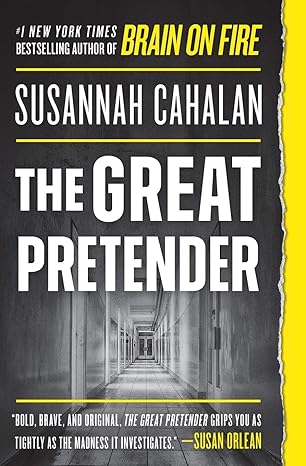
Just devoured The Great Pretender, by Susannah Cahalan:
“In 1973, a charismatic doctor convinced eight healthy people to commit themselves to mental hospitals. They had to prove their sanity to be set free. Their undercover mission would change our understanding of madness forever.” [from the cover]
Review: A riveting read–I tore through it in a few sittings. If you’re interested in how psychiatrists determine who’s sane and who’s not, I highly recommend this book!Learn more here (the author’s website) and in this review from the Guardian citing Cahalan’s “brilliant detective work.”